
Hospital Hr Onboarding Credentialing System
Hospital HR Management System
100s of hours saved
Paperless onboarding
Audit-ready trails
Multi-location compliance
*Outcomes are based on post-implementation operational feedback and time saved across HR and onboarding teams. Replace with audited metrics (cycle time, SLA adherence) if you want a strictly quantified public version.
Primary Objective
Create a single digital window to invite, onboard, credential, and verify medical staff—with compliance controls, eSignature, tasking, and reporting built in.
Client
Anonymized (Hospital / HealthTech startup)
Users:
Admin, HR, Employees, Prospective Employees
Region:
USA
Timeline:
45 Days (MVP)
Stack:
React + Vite + TypeScript, Node.js, Postgres, AWS EC2
Executive Summary
Hospital staff onboarding is rarely a “form-fill” exercise. It’s a compliance-heavy process involving personal and professional history, credentials, licenses, medical checks, background documentation, approvals, and signatures. In a paper-driven workflow, every handoff introduces delay and risk.
What changed
- From paper packets to an 11-step onboarding flow with validations and structured review.
- From scattered documents to a centralized repository on Amazon S3, with access controls and versioning patterns.
- From manual approvals to task-based routing and location-specific compliance requirements.
- From weak traceability to audit logs capturing who changed what, when, and why.
The Challenge
Onboarding a medical professional requires consistent verification of identity, credentials, education, employment, licenses, certifications, medical reports, and compliance attestation—often across multiple hospital locations. The previous paper-driven approach created friction and governance risks.
Operational pain
- Delays and SLA misses: printing, manual routing, and missing paperwork extended onboarding cycles.
- Error-prone data entry: repeated transcription of employee data across forms.
- Document chaos: hard to track “latest” licenses, certificates, and signed forms.
- Limited visibility: no real-time view of onboarding status, blockers, or expiring credentials.
Compliance and audit pain
- Weak traceability: approvals and changes weren’t centrally recorded.
- Location complexity: each hospital/site may require different license types and responsible person mapping.
- Audit readiness: compiling evidence for audits was slow and manual.
- Access control: paper workflows lack role-based guardrails.
Goals & Success Criteria
The client required a secure, scalable platform that digitizes onboarding end-to-end and supports a hospital’s operational reality—multiple roles, multiple locations, compliance thresholds, audit logs, and time-based renewals.
Business goals
- Shift onboarding from paper to a paperless digital platform.
- Enable invitation-based onboarding for prospective employees.
- Implement eSignature for required attestations and forms.
- Reduce cycle time and operational overhead from printing, tracking, and rework.
Technical goals
- Role-based access and strong authorization controls.
- High availability and maintainable monolith architecture with modular boundaries.
- Scalable file storage and secure document delivery.
- Auditability for onboarding events and credential changes.
Solution Overview
We delivered a web-based Hospital HR Management System designed as a modular monolith. The platform centralizes onboarding, credentialing, compliance, documents, and approvals—while maintaining strict role-based access and audit trails.
High-level Architecture
					Users
- Admin
- HR
- Employee
- Prospective Employee (Invite-only)
    │  (OAuth2 Auth + Role Matrix)
    ▼
React + Vite + TypeScript Frontend
- Wizard onboarding (11 steps)
- Document manager
- Reports & exports
- Tasks + approvals
    │
    ▼
Node.js Backend (Monolith with modular boundaries)
- User/role service
- Onboarding workflow engine
- Document service (S3 + metadata)
- Compliance/location service
- Tasking and notifications
- Audit log service
    │
    ├── Postgres (system of record)
    │     - employees, invitations, onboarding steps
    │     - licenses/certifications, expiries
    │     - locations, responsible persons
    │     - tasks, assignments, status history
    │     - audit logs, export requests
    │
    ├── Redis / Queue
    │     - async tasks (email, reminders, exports)
    │     - caching of dashboards + lookups
    │
    ├── Amazon S3
    │     - secure document storage (licenses, tax forms, reports)
    │     - presigned URLs + access policies
    │
    ├── Docuseal
    │     - eSignature workflows, signed PDF artifacts
    │
    └── Email
          - AWS SES (prod)
          - Mailtrap (dev/test)
This diagram represents the implemented design intent and system boundaries based on provided project details. If you want, I can also provide a Mermaid diagram version for documentation.
Modules Delivered
The platform was built around real onboarding workflows: invite, collect, validate, sign, assign, review, and approve. Every module is designed for traceability and operational clarity.
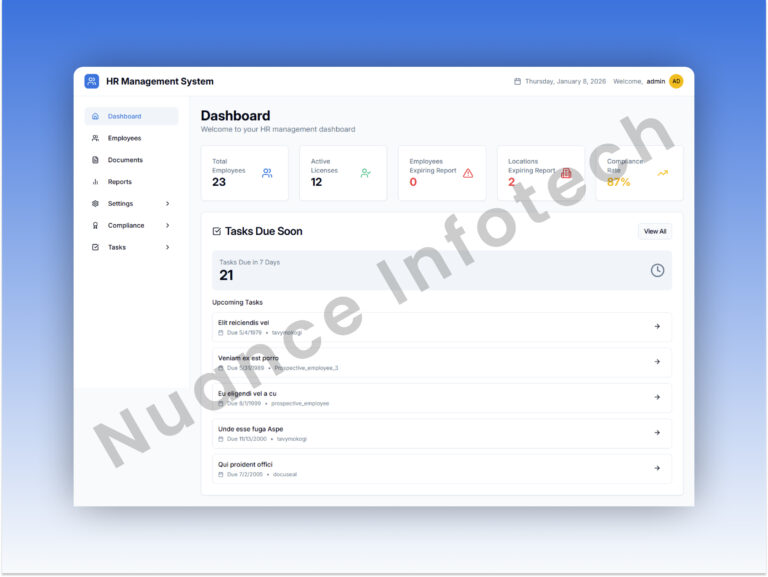
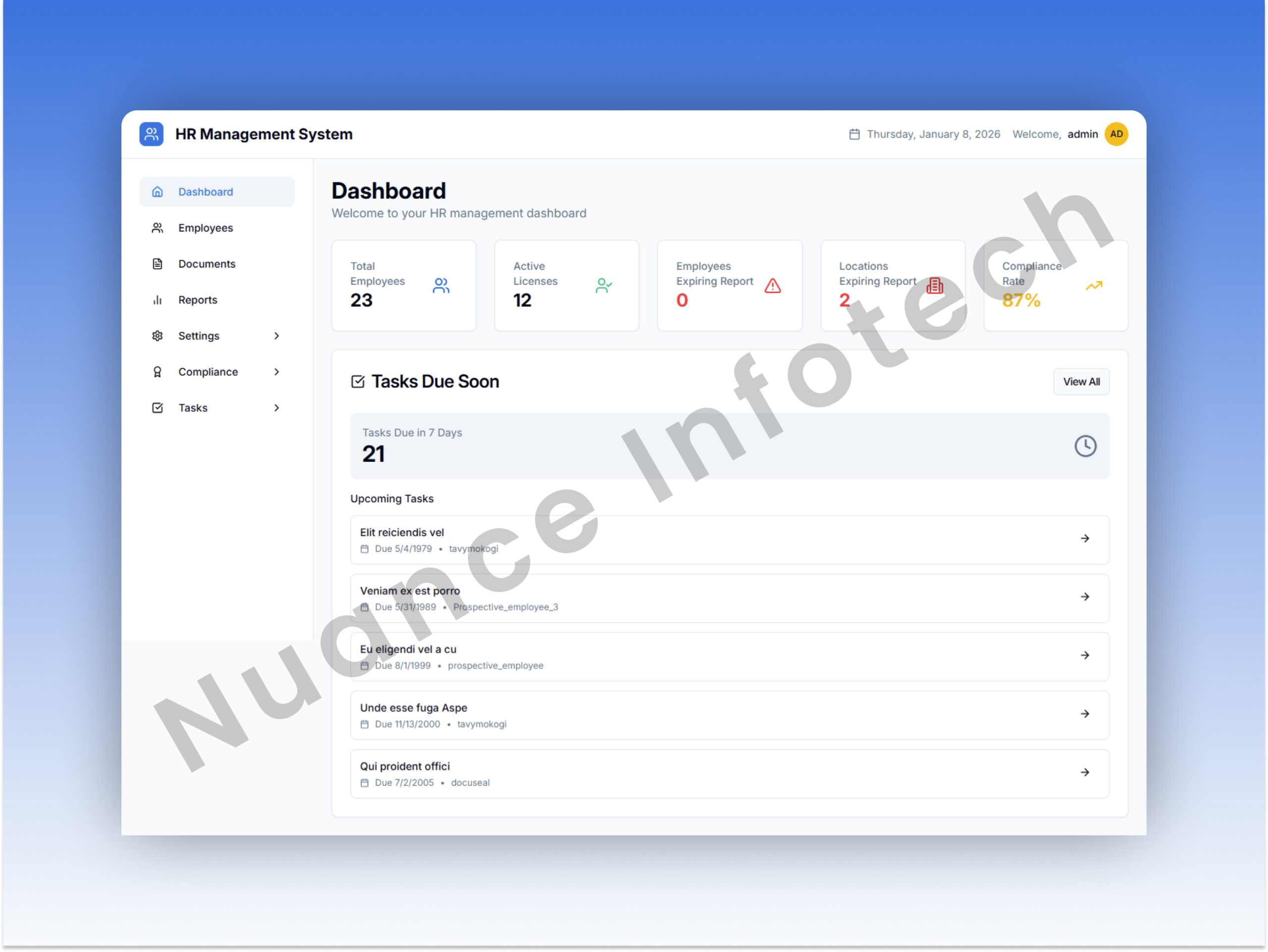
Dashboard
Role-aware overview of operational health: active employees, expiring licenses, tasks backlog, and onboarding statuses. Built to reduce “status hunting” across teams.
- Interactive metrics (active employees, expiring credentials)
- Task list and priority queues
- License alerts by threshold (e.g., expiring in 30/60/90 days)
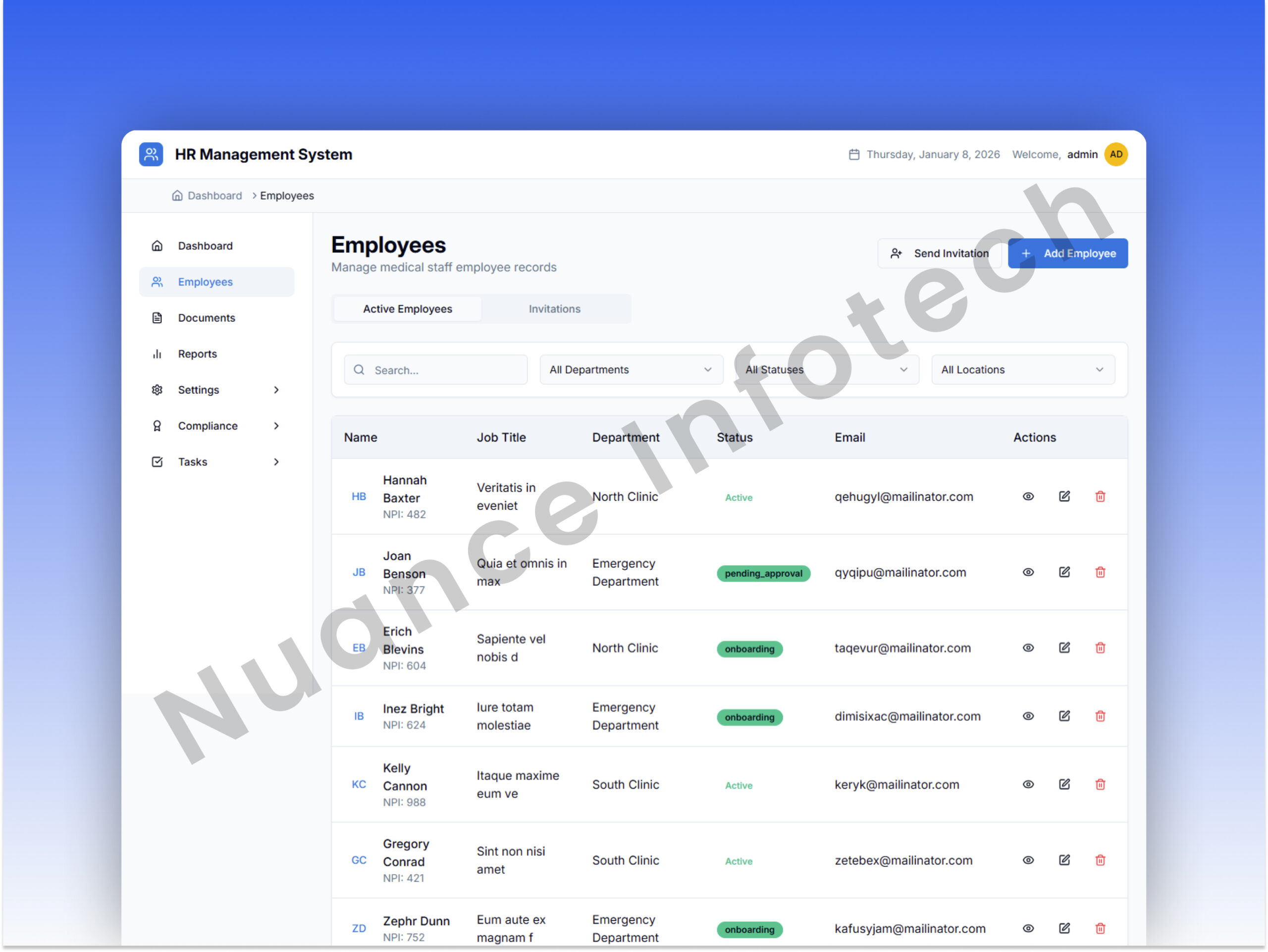
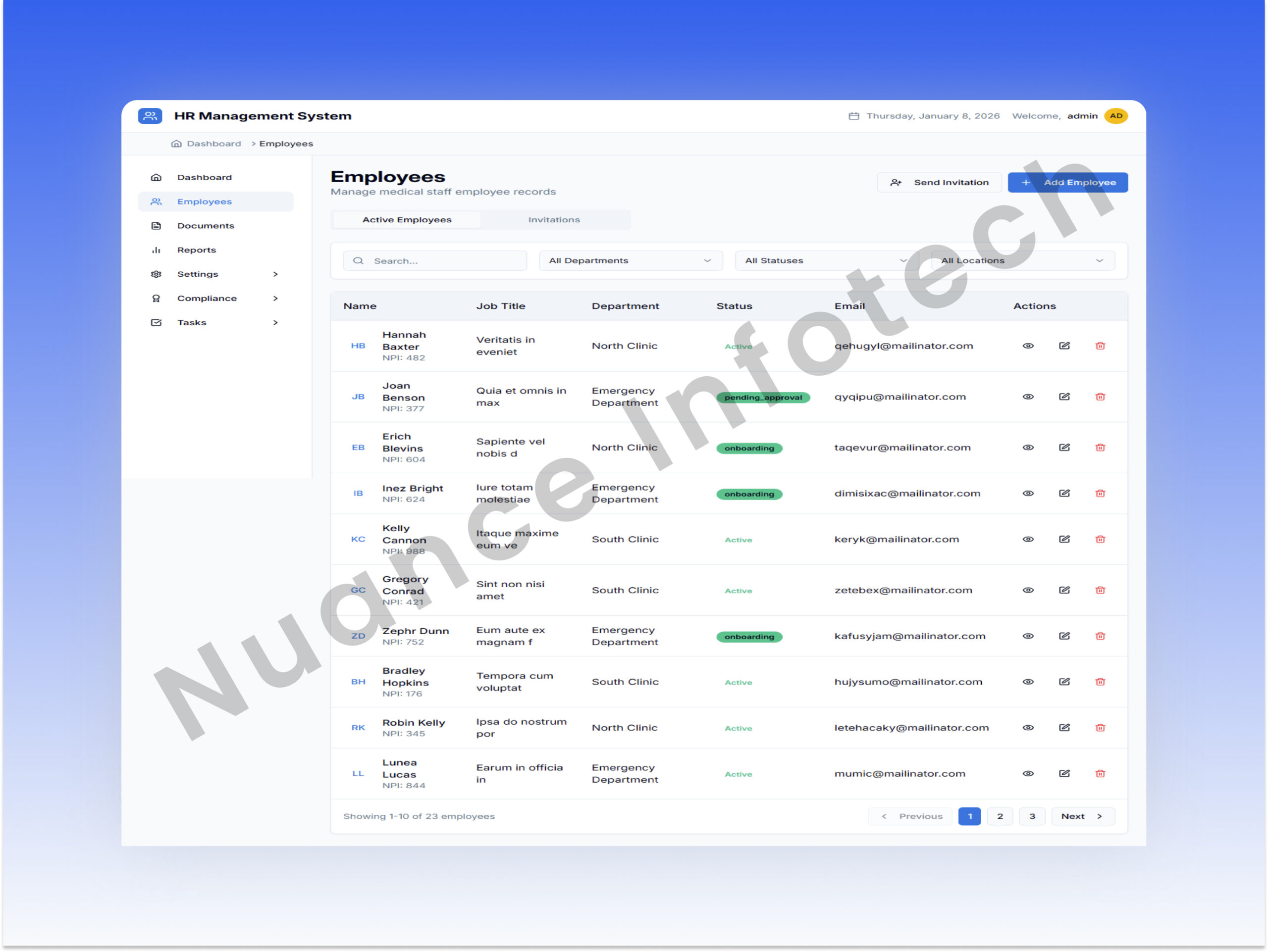
Employees & Invitations
Supports both HR-created employees and invite-first onboarding for prospective hires. Invitations establish identity, access scope, and onboarding SLA start.
- Invite flow (tokenized, expiry-based links)
- Employee lifecycle (draft → onboarding → active → inactive)
- HR-assisted onboarding (pre-fill data for speed)
11-Step Onboarding Wizard
A structured onboarding pipeline that enforces data completeness, validations, and review. Each step can be saved as draft with progress tracking.
- Personal + professional details
- Credentials, education, employment history
- Licenses/certifications with expiry tracking
- Documents upload and verification
- Medical reports and compliance attestations
- eSignature step (Docuseal)
- Final review + submission
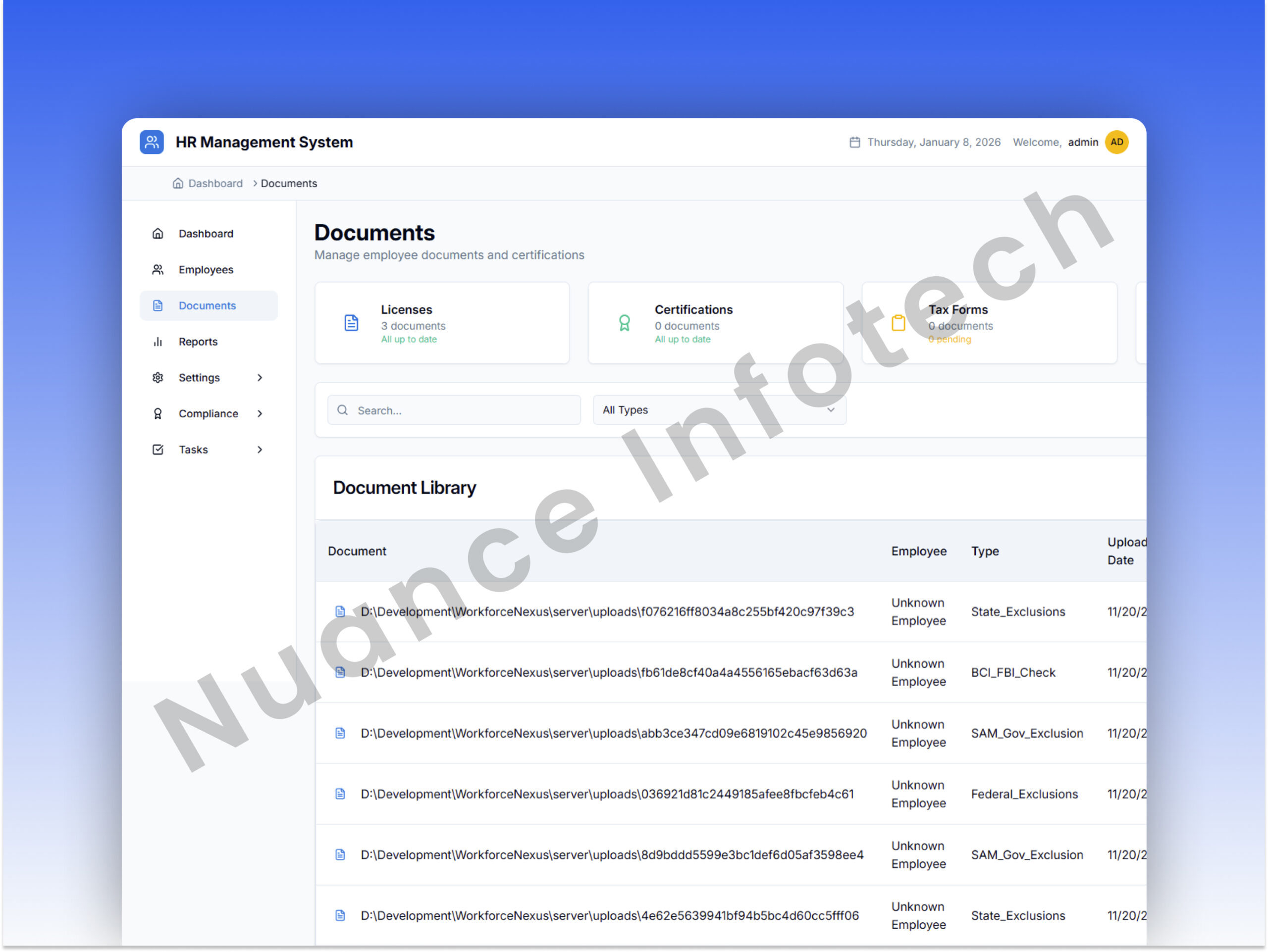
Documents
Central repository for licenses, certifications, tax forms, and supporting documents. Designed for safe access, edit/remove, and audit logging.
- Document metadata (type, issuer, expiry, linked employee/location)
- S3-backed storage with presigned download URLs
- Soft-delete + audit for governance
Reports & Exports
Operational and compliance-ready reporting with CSV/PDF exports—used for leadership reporting and audit preparation.
- Employee credential expiry reports
- Location/license expiry reports
- Employee directory exports
- Queued exports for large datasets (async)
User Management
Role-based system access across Admin, HR, Employee, and Prospective Employee. Designed for least-privilege access.
- RBAC with route guards + API enforcement
- Invitation-based access for prospective employees
- Account lifecycle (activate/deactivate, lock/unlock)
Audit Logs
Every critical operation generates an audit event: data changes, document uploads/deletes, signature actions, exports, and admin permission updates.
- Searchable logs (by user, employee, module, date range)
- Immutable event records (append-only pattern)
- Designed for audit evidence gathering
Settings & Configuration
Central configuration for email, alert thresholds, S3 parameters, API keys, and eSignature keys—kept environment aware.- SES/Mailtrap toggles per environment
- Alert thresholds (e.g., expiry warning windows)
- Docuseal key management
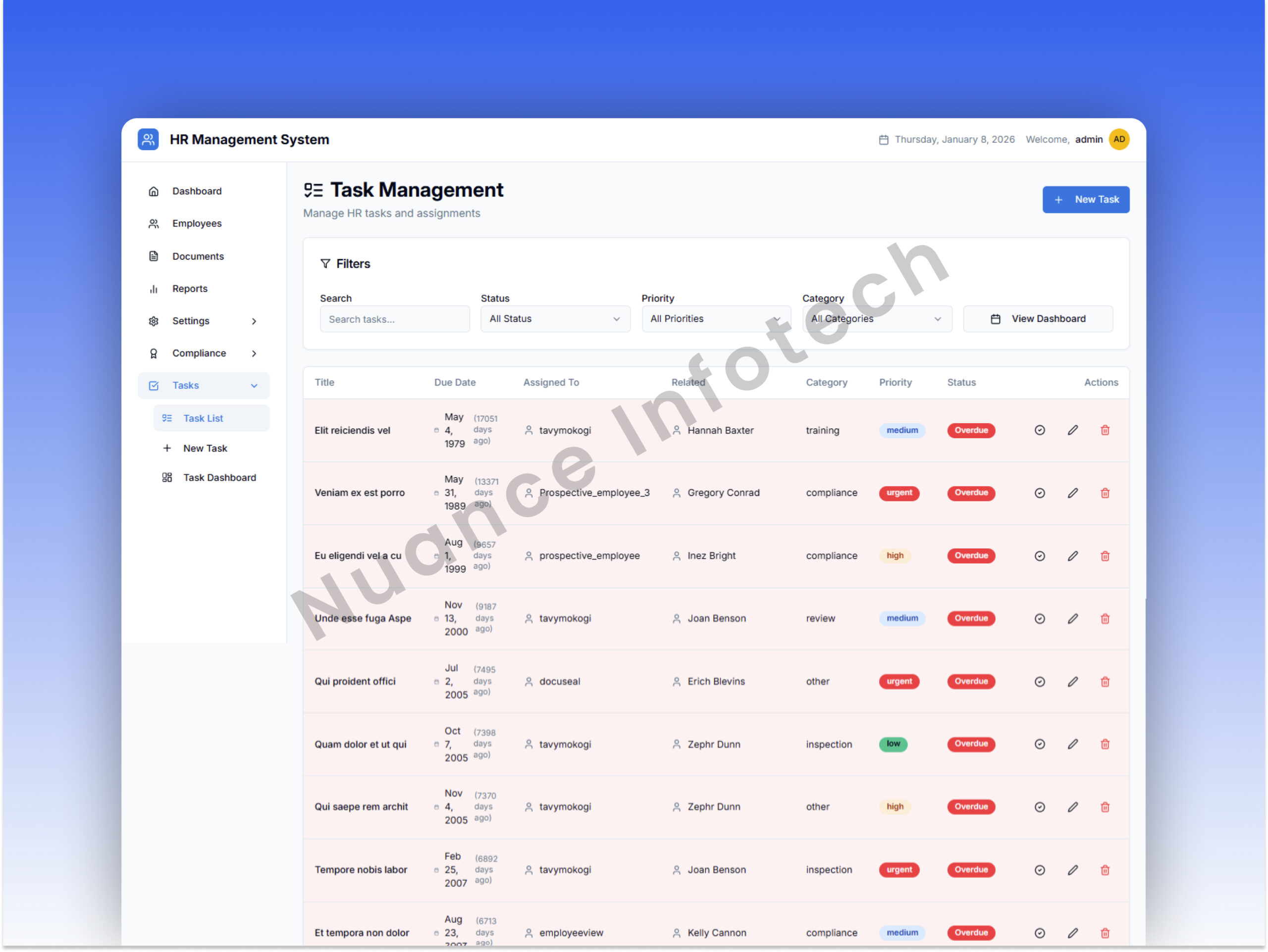
Tasks Management
A complete tasking layer for HR teams: assign tasks to users, employees, or locations; track status, comments, and due dates. Built to replace manual email follow-ups.- Task assignment (user/location/employee)
- Status lifecycle (open → in-progress → blocked → done)
- Due dates, reminders, and escalation patterns
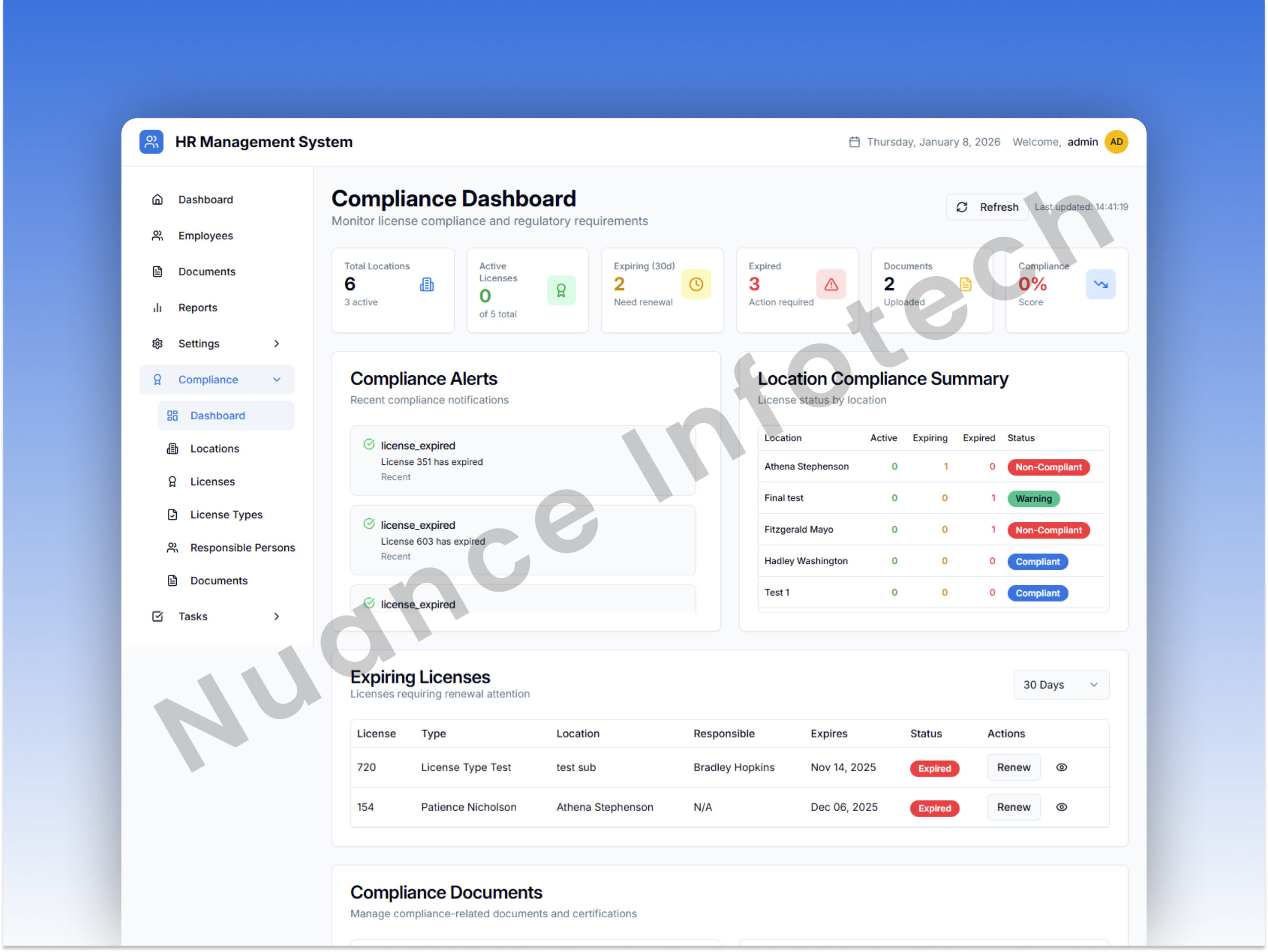
Compliance & Location Management
Models each hospital/site as a compliance unit with its own license requirements, document types, and responsible persons.
- Locations with distinct license types and requirements
- Expiry rules and automated reminders per location
Automation & AI Assistance
While core onboarding remains deterministic and compliance-driven, we introduced controlled automation to reduce manual effort—without removing human review.
Automation
| Feature | Description |
|---|---|
| Expiry reminders | automated emails for expiring licenses/certifications by threshold windows. |
| Task routing | auto-create tasks when required documents or signatures are missing. |
| Export jobs | queue-based exports to prevent UI blocking for large datasets. |
AI (human-in-loop)
| Feature | Description |
|---|---|
| Document suggestions | recommend missing document types based on role and location requirements. |
| Form assistance | suggest autofill/formatting for onboarding forms (titles, credential naming standards). |
| Task generation hints | propose follow-up tasks based on incomplete steps (HR approves before creation). |
Security, Privacy & Reliability
Security controls
- Auth: OAuth2 for secure login flows and token-based sessions.
- RBAC: role matrix for Admin/HR/Employee/Prospective Employee permissions.
- Encryption: TLS in transit; encryption at rest for database and object storage.
- Secrets management: environment-based configuration; keys not stored in code.
- Dependency hygiene: Dependabot alerts for vulnerable packages.
Reliability & performance
- CDN: faster static delivery and improved UX responsiveness.
- Redis cache: dashboard metrics, lookups, and frequently accessed datasets.
- Async queues: email notifications, export jobs, reminder scheduling.
- Observability-ready: structured logging and dashboard health checks (recommended).
Delivery Process
Methodology
- Agile sprints with weekly demos and stakeholder validation.
- Design and UX iteration focused on reducing onboarding friction.
- Environment separation: dev / stage / prod for safe releases.
Testing & QA
- Unit tests for workflow rules and step validations.
- Playwright E2E for invite links, onboarding wizard, docs upload, eSignature, and exports.
- Regression checks per sprint to avoid reintroducing paper-era issues.
Outcomes & Impact
Measured / reported outcomes
- 100s of hours saved: reduced printing, scanning, chasing signatures, and manual compilation.
- Lower costs: paperless operations + fewer errors and rework cycles.
- Smoother adoption: invitation-based onboarding improved completion and reduced HR follow-ups.
- Audit readiness: searchable logs and exportable reports reduced audit preparation overhead.
Client feedback (representative)
Technology Stack
Core stack used
Lessons Learned & Best Practices
1) Treat onboarding as a workflow engine, not a form
- Breaking onboarding into 11 steps reduced overwhelm and improved completion.
- Draft saves and progressive validation reduced data loss and re-entry.
- Review steps created a controlled checkpoint before HR approval.
2) Document handling is the hardest part—design it early
- S3 storage with metadata prevented “file chaos” and made reporting feasible.
- Presigned URLs reduced exposure risk while allowing smooth downloads.
- Soft-delete + audit logging protected governance.
3) Compliance is location-specific—model it explicitly
- Location management enabled per-site requirements without duplicating employee profiles.
- Responsible person mapping reflected real operational ownership.
- Expiry thresholds and reminders reduced last-minute credential lapses.
4) Automation must reduce HR workload, not create noise
- Task creation rules were designed to be actionable, not spammy.
- Queue-based exports improved reliability at scale.
- Human-in-loop AI ensured recommendations didn’t bypass compliance judgment.