01Primary Objective
Primary Objective
Give Roadrunner customers one website where they can track, quote, book (Bill of Lading) and report online at any time, so everyday shipping tasks no longer need a phone call or an email.

Building a secure self-service portal where Roadrunner Freight customers track shipments, get freight quotes, create a Bill of Lading and run account reports in one place, connected to Roadrunner's rating, tracking, BOL and customer portal systems.
Jump to the result01Primary Objective
Give Roadrunner customers one website where they can track, quote, book (Bill of Lading) and report online at any time, so everyday shipping tasks no longer need a phone call or an email.
02Project Details
| User type | What they can do |
|---|---|
| Guest | Track shipments, view proof of delivery, get LTL and volume quotes, view maps and documents, request an account |
| Logged-in customer | Everything a guest can do, plus dashboard, Bill of Lading, BOL management, reports, all shipment documents, notifications and account pricing |
| Customer account | The accounts linked to a login, used in quotes, BOLs, reports and saved data |
03Executive Summary
Roadrunner customers needed a modern, self-service way to handle daily shipping tasks. We built a Next.js customer website that connects securely to Roadrunner’s SOAP and REST services and customer portal API, turning complex freight operations into simple guided screens.
04The Challenge
Freight customers handle many shipments, documents and accounts every day. Doing this through calls and emails is slow for customers and costly for the carrier.
05Goals and Success Criteria
06Solution Overview
The website is built with Next.js 16 (App Router) and React 19. The browser only calls the website’s own /api routes; the server then adds the right login or token and calls Roadrunner web services or the customer portal API. Responses are turned into simple screens and clear messages.
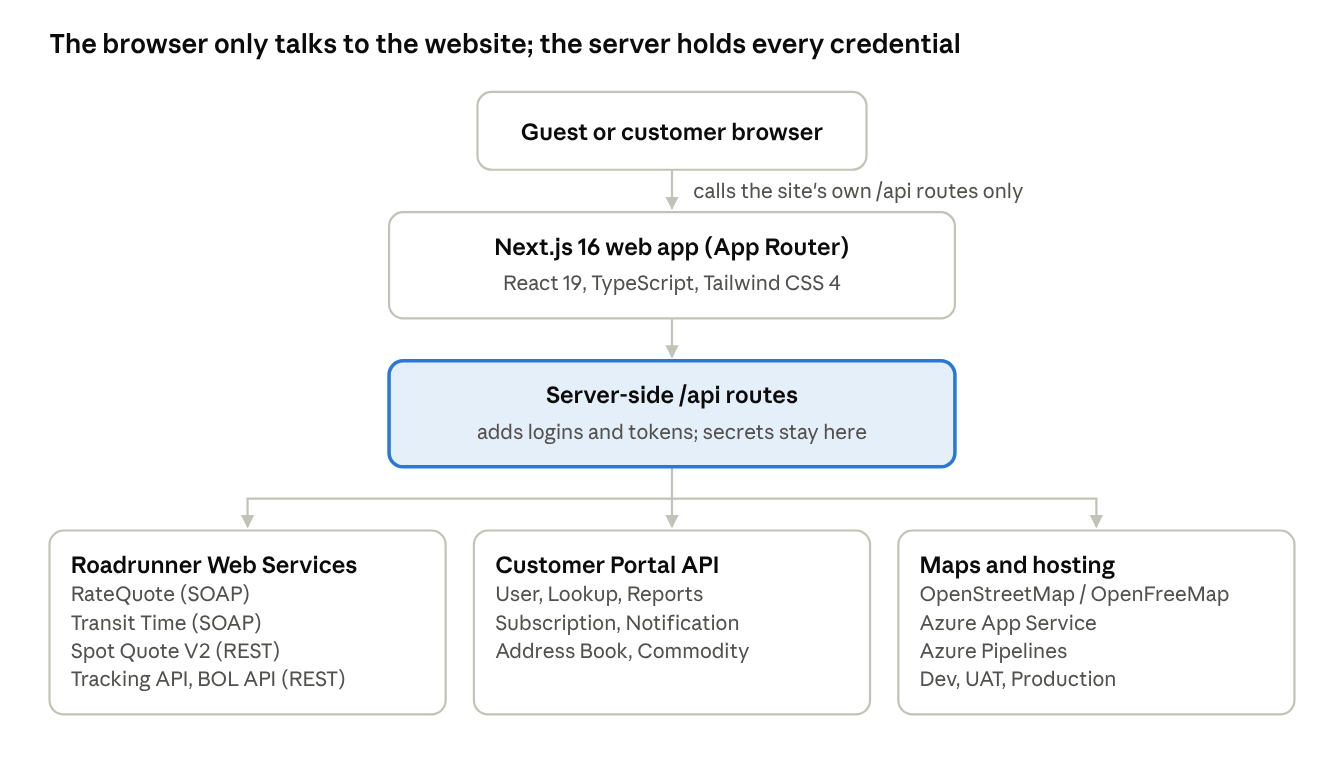
Every request passes through the server-side /api layer, so service logins and API keys never reach the browser.
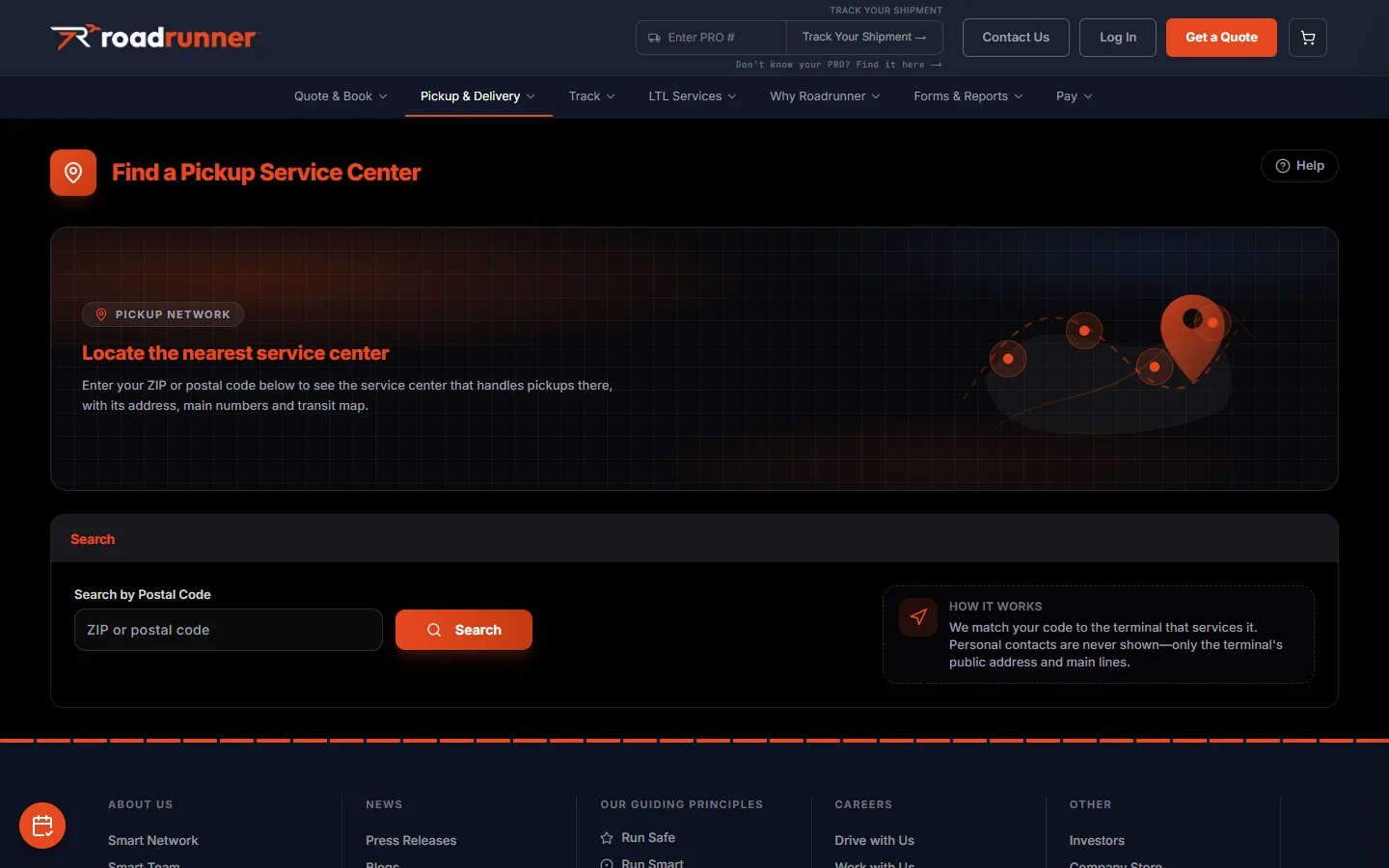
07The product, live
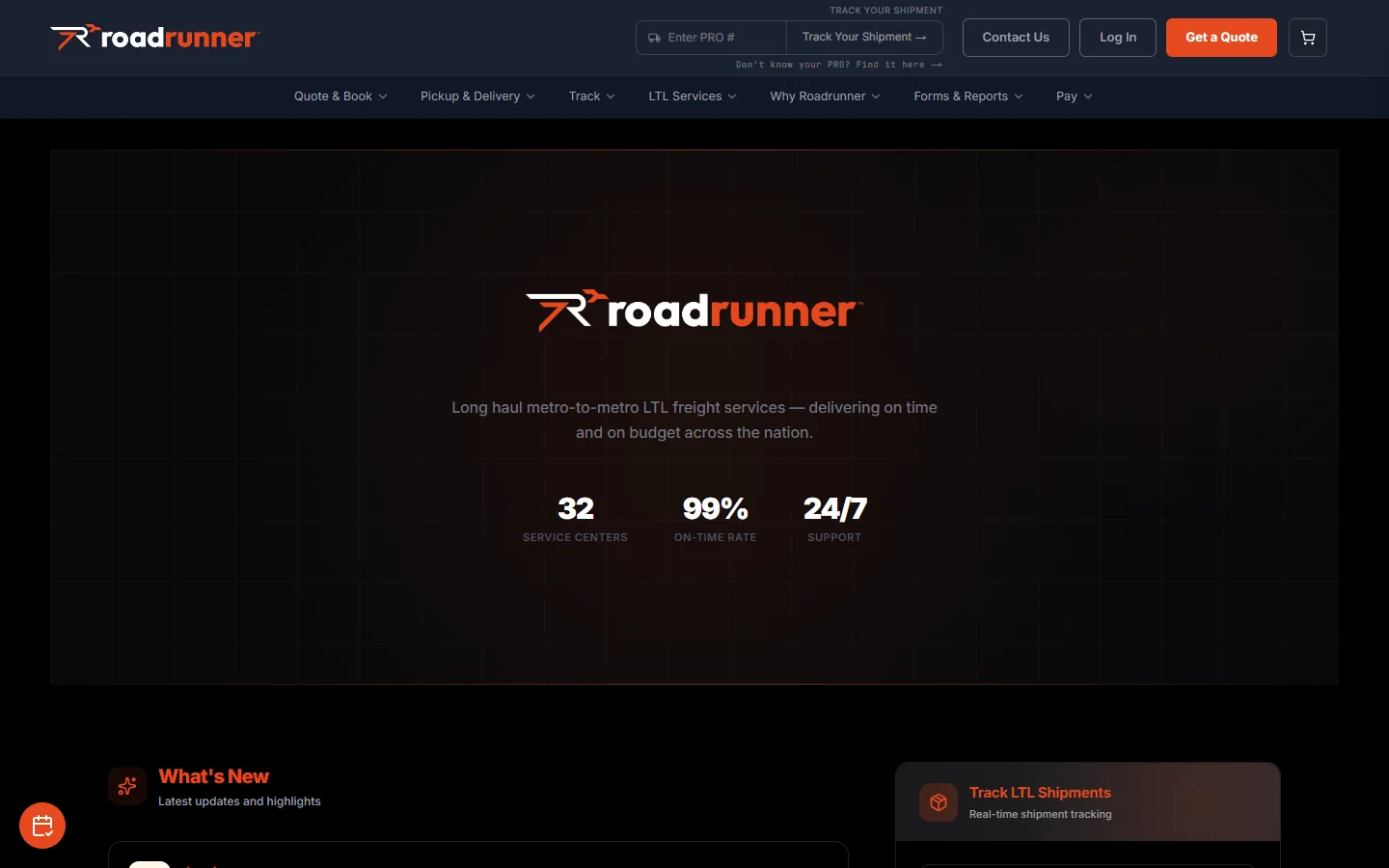
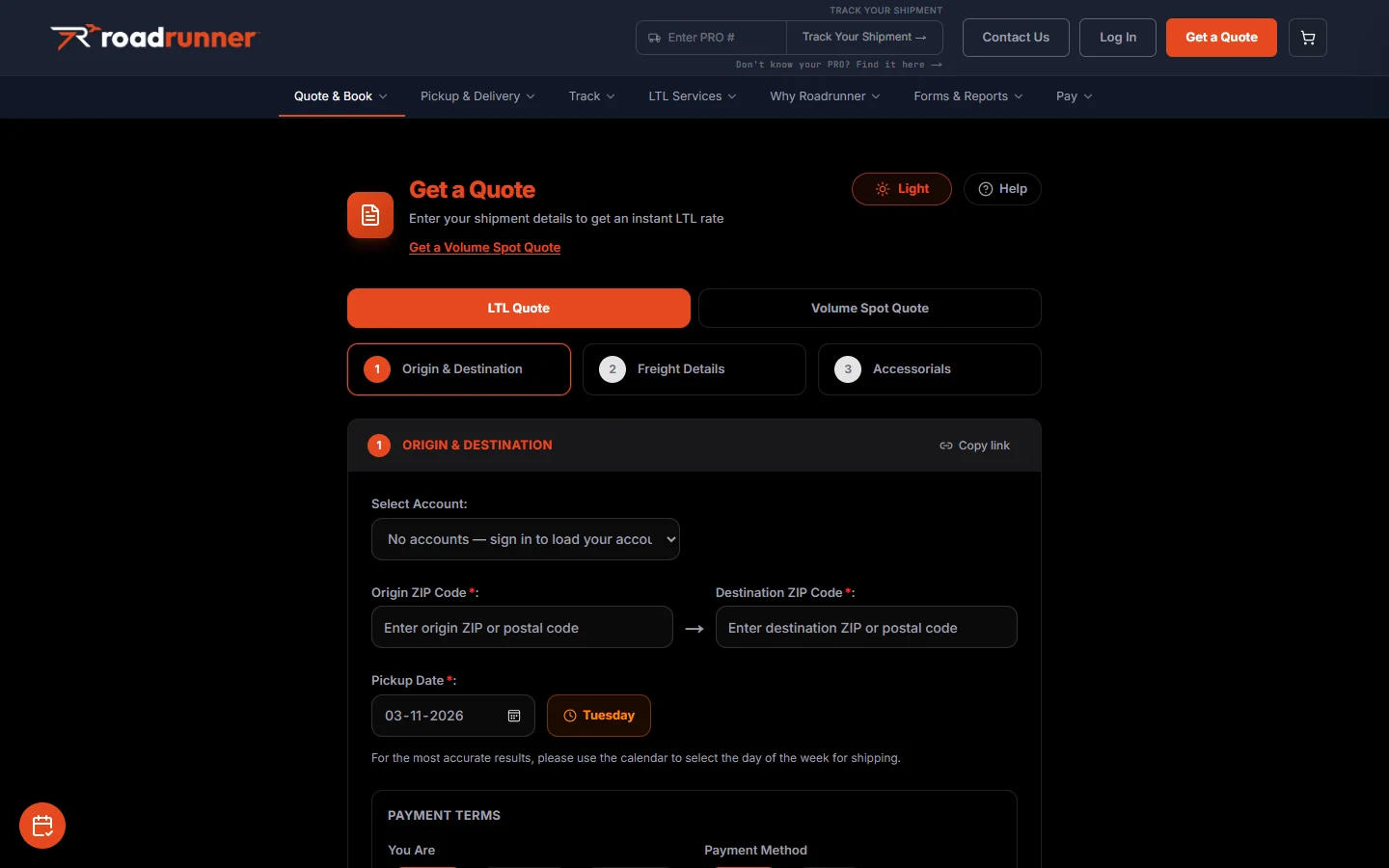
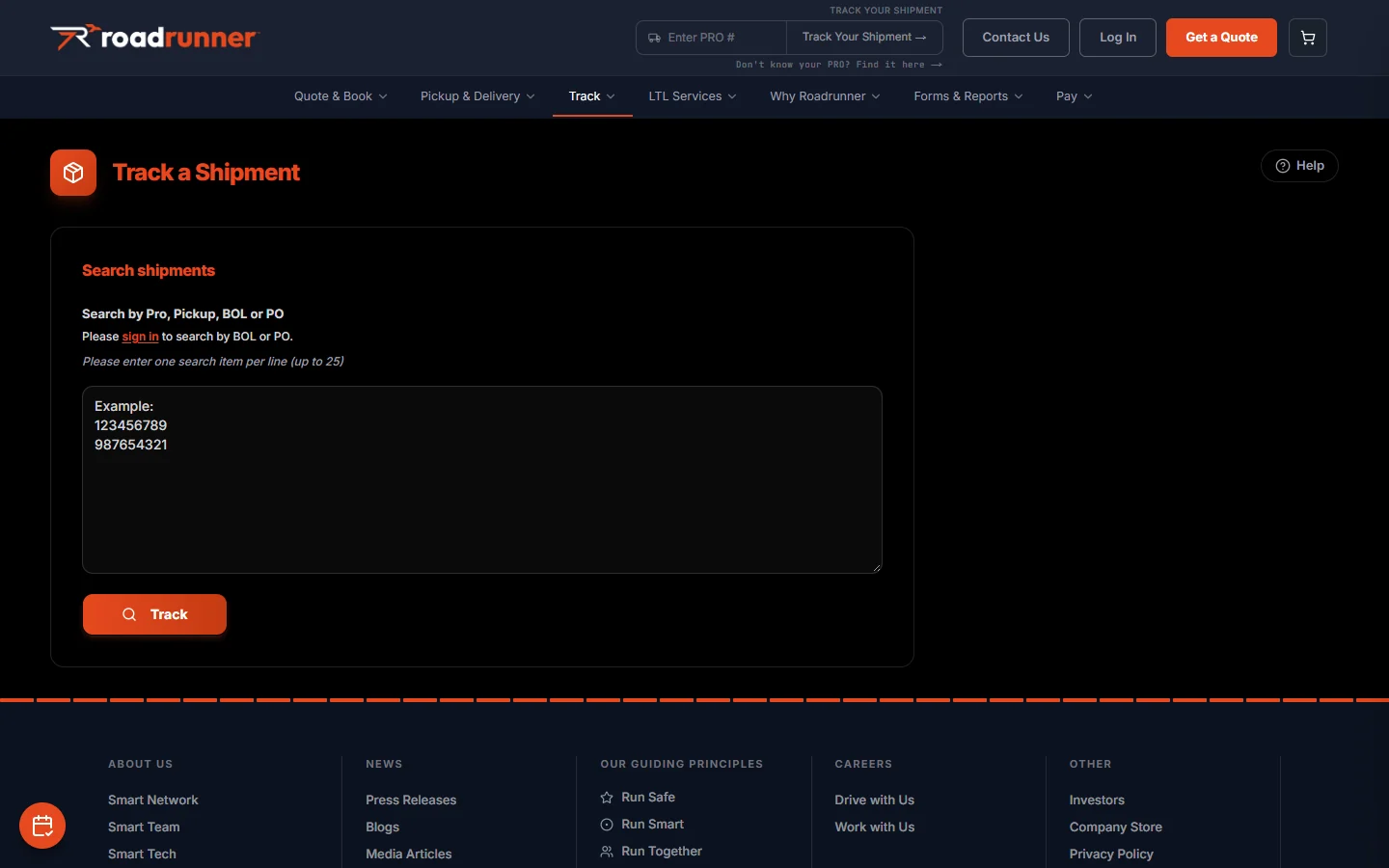
Screenshots of the live product, taken on 3 November 2026.
08Product Modules Delivered
23 modules grouped into six areas, covering every common customer task.
| Area | Modules | What it does |
|---|---|---|
| Quoting | 5 | Step-by-step LTL quote with transit days, Smart Guarantee and estimated total; Volume Spot Quote; quote cart with printable receipt; transit time tool; density calculator |
| Shipment Tracking | 3 | Track up to 20 PRO numbers with status, map, timeline and signature; download POD, BOL, invoice and inspection images; email and text notifications |
| Bill of Lading | 2 | Four-step BOL form with instant PDF; start a BOL from a quote; saved addresses, commodities and BOL history |
| Reports | 2 | 8 account reports (Aging, BOL History, Consignee/Shipper Status and more) filtered by account and date; scheduled email delivery |
| Account and Security | 5 | Login/logout, account request, password reset, linked customer accounts, profile and notification preferences |
| Dashboard and Information | 6 | Dashboard with shipment summary and quick actions; map of 41 service centers; ZIP-based center search; label maker; document download center |
09Backend Services
| Service | Used for |
|---|---|
| RateQuote (SOAP) | Standard LTL rates, with account pricing for logged-in customers |
| Transit Time (SOAP) | Transit business days |
| Spot Quote V2 (REST) | Volume spot rates and the accessorial list |
| Tracking API (REST) | Shipment data and document images |
| BOL API (REST) | Creates the BOL and returns the PDF |
| Customer Portal API | Auth, lookups, reports, subscriptions, notifications, address book and commodities |
| OpenStreetMap / OpenFreeMap | Map tiles and city locations for the shipment map |
10Key Business Rules
| Rule | Details |
|---|---|
| Volume shipment | 12+ linear feet counts as volume, insured at $1 per lb up to $100,000 |
| Insurance | Standard LTL includes $1 to $10 per lb by freight class, up to $50,000 |
| Dates | Pickup date cannot be in the past; BOL ship date must be within 31 days |
| Dimensions | Cubic feet = length × width × height (inches) ÷ 1,728 |
| Accessorials | Chosen from Roadrunner’s live list; a BOL allows up to 5 |
| Delivery dates | Estimated dates skip weekends and carrier holidays |
| Accounts | Reports and saved data are limited to the customer’s own accounts |
11Security, Privacy and Performance
12Delivery Process
13Outcomes and Business Impact
14Technology Stack
| Area | Technology |
|---|---|
| Framework | Next.js 16.2.1 (App Router) |
| UI and language | React 19.2.4, TypeScript 5 |
| Styling and components | Tailwind CSS 4, shadcn with Base UI, lucide-react icons |
| Forms and validation | Formik 2.4, Yup 1.7 |
| API and SOAP | Axios 1.15, fetch, fast-xml-parser 5.8 |
| Maps and messages | Leaflet 1.9 with MapLibre GL 5.24, Sonner toasts |
| Testing and quality | Node.js test runner, ESLint 9 |
| Hosting | Azure App Service, Node.js 22, Azure Pipelines |
15Lessons Learned and Best Practices
Result
23 modules
Across quoting, tracking, BOL, reports, account and dashboard
20 shipments at once
Track up to 20 PRO numbers in a single search
8 account reports
With scheduled email delivery, daily to yearly
Dev, UAT, Production
Automated deployments with Azure Pipelines
Technology
Start a conversation
Bring the workflow, the system or the feature. An engineer reads every message and replies with a suggested first step, usually a small fixed-price assessment rather than a sales deck.
One workflow is enough. We’ll reply with what a first step looks like.